Maud Dowley was born in 1903 in South Ohio, Nova Scotia. Her father was a successful blacksmith and harness maker. Her body disfigured by birth defects, Maud had sloped shoulders and her chin rested on her chest. She quit school at age 14 to escape the mocking of her classmates. It was her mother who taught her how to draw, paint, crochet, and carve wood. She even learned to play the piano before arthritis curved her hands too small to reach the keys.
In the early 1930s, her parents died within two years of each other. She briefly lived with her brother and his wife, and later with an aunt.
Maud was 34 when she responded to a note posted on a local bulletin board. “Live-in or keep house for a 40-year-old bachelor.” In early January of 1938 Maud arrived at fishmonger Everett Lewis’ tiny 9×10.6-foot house in Marshalltown. They married several weeks later and lived the rest of their lives there. That’s when Maud really started painting.
Diane and Barry Cowling’s 1976 short film about Maud’s life begins: “You know how you keep a little of your childhood inside you? A place to go when things aren’t going right? That’s what you see when you look at Maud’s paintings. It’s that world. When you were a child. A world with no shadows in it.”
In the spring, summer and fall, Maud would accompany Everett as he sold fish to the residents of Digby and Yarmouth counties in southwestern Nova Scotia. Sometimes she’d sell her hand painted cards for five or ten cents each to make a little extra money.
In the winter, she’d paint, creating scenes based on what she’d seen on her travels along the local roads. “I imagine and paint from memory,” she once told a reporter. “I don’t copy much… just have to guess my work up.”
Eventually, painting cards wasn’t enough to meet demand, and Maud began painting on wood, Masonite, cardboard, particle board, clam shells, and even dustpans. Everett made a sign that he posted outside of their small roadside house, “Paintings for Sale. M. Lewis.” During the last few years of her life, a stop at Maud’s to pick up a painting became a popular tourist attraction on the road between Yarmouth and Digby.
Maud’s paintings are whimsical and joyous scenes of everyday rural life. She only painted exterior scenes and while there are some recurring themes and landmarks that are well-known to locals, she also dabbled in fantasy – a world where pine trees had colorful blossoms and animals roamed freely.
As you probably know, Maud Lewis eventually became famous for her paintings. Recognition (and money) didn’t arrive until after her death, sadly, but today she is considered a national treasure in Canada.
In 2019, she was the subject of Nova Scotia Heritage Day. The provincial holiday recognizes “a person, place or event that helped shape the province’s history and identity.” Four commemorative stamps were issued by Canada Post in her honor.
Interest in her work has continued to grow along with the value of her paintings.
In 2009, her painting The Family Outing sold for $22,000 at an auction in Toronto. Her Portrait of Eddie Barnes and Ed Murphy, Lobster Fishermen, Bay View, N.S., which was found at an Ontario thrift store in 2017, sold for $45,000 at an online auction later that year.
Lewis’s painting Black Truck was traded by artist John Kinnear to an Ontario restauranteur in 1973 in exchange for an artisanal grilled cheese sandwich. It sold for $350,000 in 2022. Three hand-written letters by Lewis to Kinnear, in which she thanked him for helping to support her work, sold for $70,000.
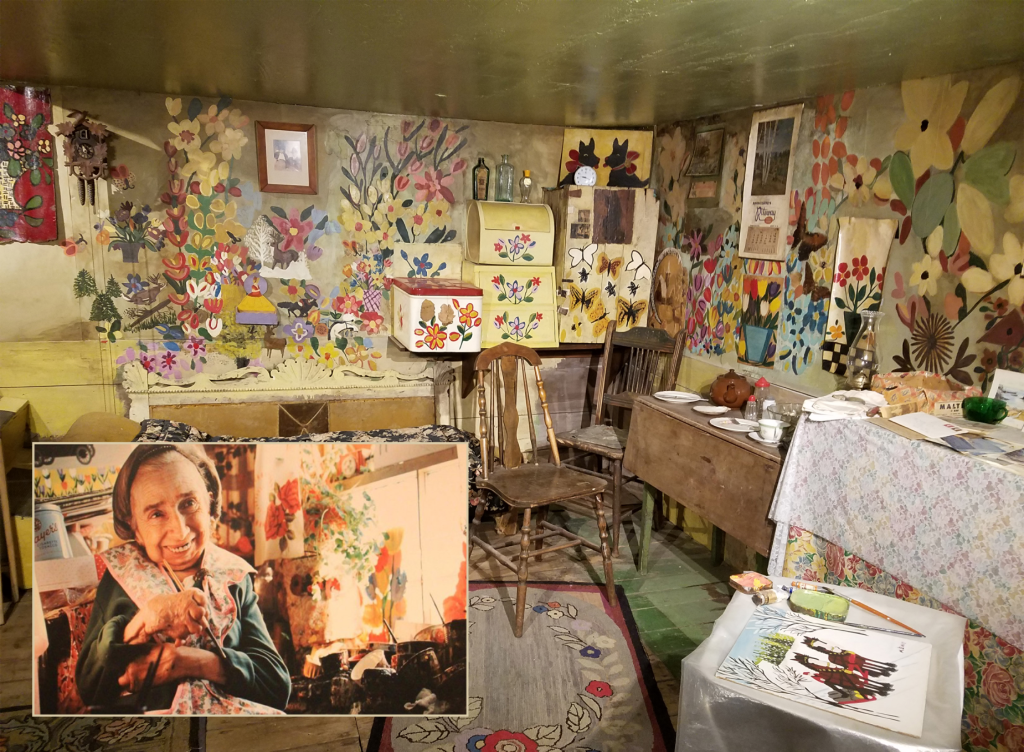
In my view, however, the most inspirational and valuable artifact of Maud Lewis’ life is found at the Art Gallery of Nova Scotia in Halifax. There, in a wing dedicated to her work, sits Maud and Everett’s house.
The house was purchased in 1980, a year after Everett died, and in 1984 was put under the care of the Art Gallery of Nova Scotia. After a decade of conservation, the house was rebuilt in the gallery space and unveiled in 1994.
Maud’s house is a creative thinker’s dream. Every nook and cranny, the door, walls, cupboards, stairs to the loft, stove and nearly everything that is seen bursts with Maud’s colorful and celebratory touch. It’s a tribute to a flourishing mind that explodes from a diminutive and restricted body.
I’ve visited the gallery two or three times thanks to the fact that my son, Zach, lives in Halifax. But I think about Maud’s house a lot. Maud’s house is a reminder that we all have creativity that can explode out of us if we let it.
We too often hold back for fear of embarrassment or getting caught up in the need to make a product that’s a commodity rather than an expression of what’s inside of us. Yes, we all need to pay the bills and get butts in the seats, but along the way – once in a while – we need to remember to open the doors so that the colorful and imaginative energy that’s trapped can escape. The results might surprise us.
Maud’s paintings are wonderful and important examples of folk art. But her home, painted for no one to see, unconcerned with commerce and commodities – that’s the inspiration.
When we dive into our childlike wonder and remember why we went into this work in the first place, we are reminded that much of our passion and determination is rooted in what allows us to explore our creativity, rather than what’s created just because it might sell.
Let Maud’s house inspire you in 2024 and help us to get back to our creative roots a little more often.

 Creative Problem Solving and Organizational Development